
VIKSHIT BHARAT 2047: INDIA'S ROAD TO A DISTANT SUNRISE


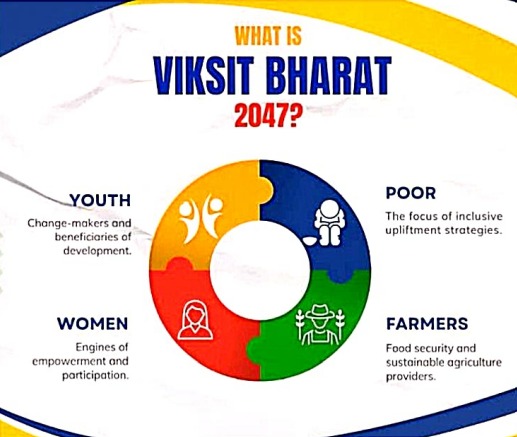
The vision of Viksit Bharat 2047 appears like a radiant sunrise on the horizon-promising warmth, progress, and renewal. It inspires confidence ina young nation eager to claim its rightful place in the world. Yet history reminds us of a simple truth: a sunrise admired from a distance does not shorten the night. Only disciplined movement toward it does. Viksit Bharat 2047 envisions India as a developed nation by the centenary of independence-economically strong, socially inclusive, technologically advanced.environmentally responsible, and institutionally efficient. For India's youth, thisvision is not a ceremonial slogan; it is a promise of opportunity, dignity, and global parity. It defines the quality of education we will receive, the jobs we willcompete for, and the nation we will inherit.
Before we celebrate the destination, it is time to measure the distance. As of 2023-24, India's per capita income stands at approximately USD 2,500, while developed nations typically cross USD 12,000-15,000. Bridging this gap requires 7-8% sustained economic growth for decades, alongside parallel gains in health, education, and productivity. Current projections of 6-7% growth are respectable, but they fall short of what the 2047 ambition demands. For a generation that will live the consequences of today's policies, this gap cannot be ignored.
Too often, policy responses resemble fireworks in the night sky-bright at launch,applauded briefly, and forgotten once the smoke settles. Schemes multiply, platforms expand, and targets are announced, yet execution remains uneven. Fireworks attract attention, but they do not illuminate the road ahead. Development requires continuity, not episodic enthusiasm.
Economic progress itself has become a wide but shallow river-visible movement without sufficient depth. GDP numbers rise, yet stable employment, productivity growth, and wage security lag behind. Education increasingly functions like an assemblyline producing degrees, while the economy demands skills and adaptability. Governancewears polished digital glass, but responsiveness often remains behind the screen. Environmental commitments risk becoming post-dated cheques written to the future, while ecological costs accumulate interest in the present.
From the perspective of a young citizen, the concern is not ambition-it is accountability. When goals are placed too far into the future, urgency dissolves and responsibility quietly shifts to the next generation. That is why the real test of Viksit Bharat lies not only in 2047, but in what India achieves by 2026.
From the perspective of a young citizen, the concern is not the vision-it is the timeline.When goals are placed too far ahead, urgency dissolves. Accountability weakens. Responsibility quietly shifts to the next generation. That is why the real test of Viksit Bharat lies not only in 2047, but in what India achievesby 2026. Nations do not transform through distant promises; they transform through short, measurable, and time-bound milestones-better jobs, stronger learning outcomesresponsive governance, and enforceable sustainability.
Viksit Bharat 2047 must not remain a lighthouse admired from the shore while the ship stays anchored. It must become a navigational chart-marked with milestones, corrections, and steady movement. Otherwise, 2047 will arrive as a date on the calendar, not as proof of transformation.
Viksit Bharat 2047 envisions India as a fully developed nation by the centenary of its independence-economically strong, socially inclusive, technologically advanced, and globally influential. It implies a nation with high per capita income, world-class infrastructure, quality education, robust healthcare, sustainable cities, and institutions that are efficient, transparent, and accountable. For India's youth, this vision is not abstract idealism; it is a promise of opportunity, dignity, and global parity.
Policy responses often resemble fireworks in the night sky-spectacular at launch, applauded briefly, and forgotten once the smoke clears. Schemes multiply, portals expand, and targets are announced, yet execution remains uneven. Fireworks attract attention, but they do not illuminate the road ahead. Development demands sustained follow-through, not momentary brilliance.
Viksit Bharat 2047 cannot remain a lighthouse admired from the shore while the ship stays anchored. It must become a navigational chart-marked with milestones, corrections, and constant movement. Otherwise, 2047 will arrive not as a celebration ofachievement, but as a reminder that ambition, without execution, is merely delay. The future of India will not be decided by how far we look, but by how honestly we actstarting today.
|| JAI HIND ||